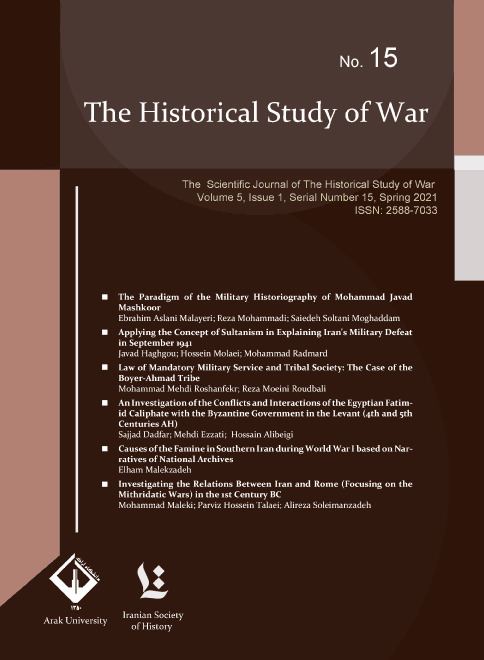
The law of mandatory military service was one of the plans of the Pahlavi government, which received protests from the tribal community. One of the tribes that strongly resisted this law was the Boyer-Ahmad tribe. Two questions arise in this regard, which were dealt with in the present study, as to why the tribal community, led by the Khans, resisted this law, and what the Pahlavi government aimed in designing this law. The findings show that tribal society has always been one of the centers of local power that opposed any change in the political and social structure of the tribal pyramid. The Pahlavi government also saw tribal society as a manifestation of many of the obstacles to national solidarity and nation-state building that must be removed. Therefore, the conscription program would result in both the removal of the power of tribal society and an increase in the power of the central government. The alienation of the government by the masses of the tribal people and the bribery of the enforcers of this law caused more hatred towards the government.
Roshanfekr,M. M. and Moeini Roudbali,R. (2021). Law of Mandatory Military Service and Tribal Society: The Case of the Boyer-Ahmad Tribe. Historical Study of War, 5(1), 47-67. doi: 10.52547/HSOW.5.1.47
MLA
Roshanfekr,M. M. , and Moeini Roudbali,R. . "Law of Mandatory Military Service and Tribal Society: The Case of the Boyer-Ahmad Tribe", Historical Study of War, 5, 1, 2021, 47-67. doi: 10.52547/HSOW.5.1.47
HARVARD
Roshanfekr M. M., Moeini Roudbali R. (2021). 'Law of Mandatory Military Service and Tribal Society: The Case of the Boyer-Ahmad Tribe', Historical Study of War, 5(1), pp. 47-67. doi: 10.52547/HSOW.5.1.47
CHICAGO
M. M. Roshanfekr and R. Moeini Roudbali, "Law of Mandatory Military Service and Tribal Society: The Case of the Boyer-Ahmad Tribe," Historical Study of War, 5 1 (2021): 47-67, doi: 10.52547/HSOW.5.1.47
VANCOUVER
Roshanfekr M. M., Moeini Roudbali R. Law of Mandatory Military Service and Tribal Society: The Case of the Boyer-Ahmad Tribe. Historical Study of War, 2021; 5(1): 47-67. doi: 10.52547/HSOW.5.1.47